

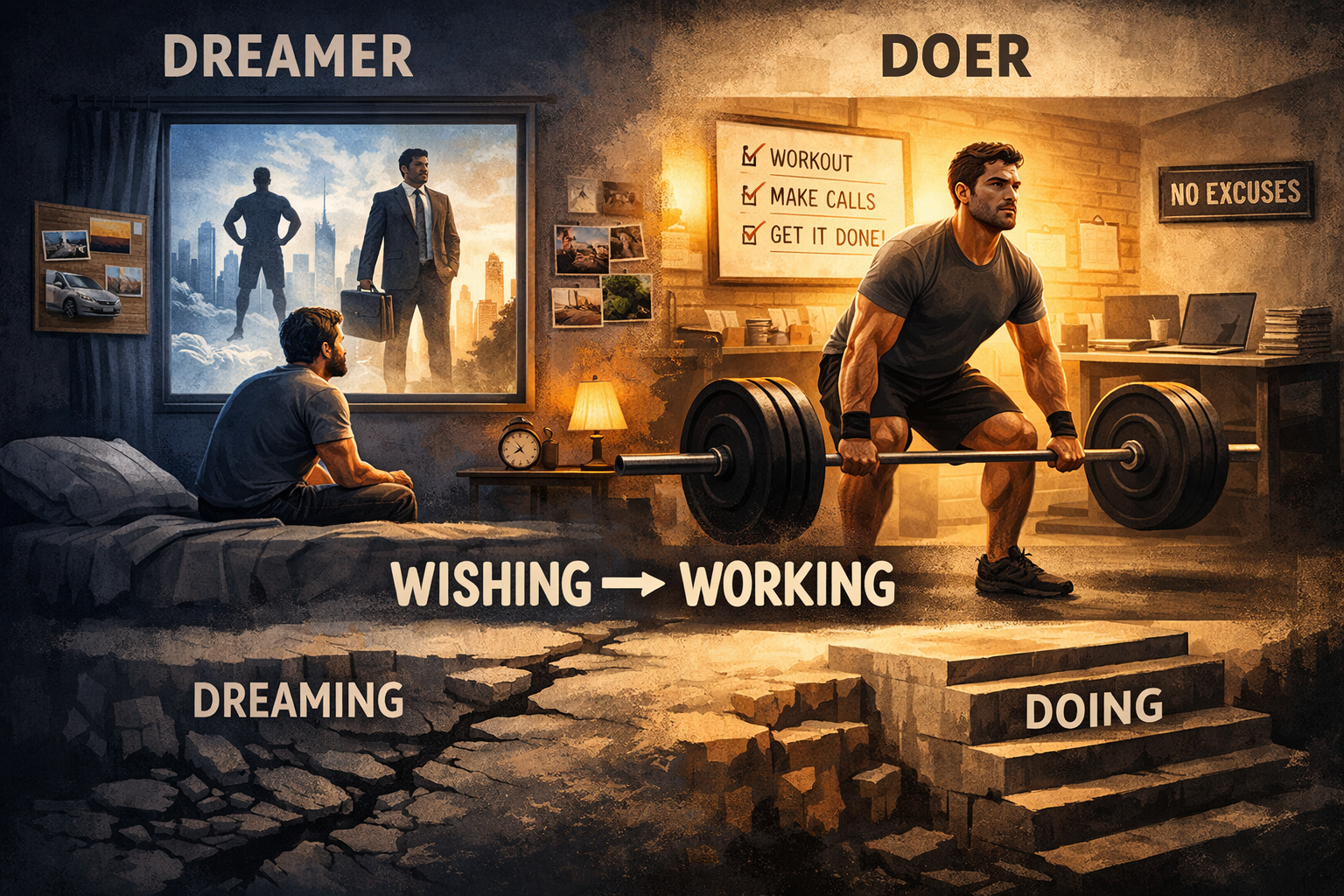
Dreaming Isn’t Doing: The Cost of Living in Possibility Instead of Reality
Many people dream about success but never take action to achieve it. This article breaks down why staying comfortable keeps you stuck, how dreaming becomes an illusion of progress, and what it takes to shift from thinking to execution and real results.
There’s a version of you that exists only in your head.
That version is sharper, richer, more disciplined. They wake up early, execute relentlessly, and build the life you claim you want. You visit that version often—late at night, in moments of isolation, in bursts of motivation. You can see it clearly.
But you don’t live there.
You stay where it’s comfortable.
The Addiction to Possibility
Dreaming feels productive—but it’s a psychological illusion.
When you imagine success, your brain releases a small reward. You feel like you’re progressing, even though nothing has changed. You visualize the business, the physique, the lifestyle—and for a moment, it satisfies the desire without requiring the work.
That’s the trap.
You’re not building the life.
You’re consuming the idea of it.
Over time, this creates a dangerous loop:
You dream → you feel good
You feel good → you delay action
You delay action → nothing changes
Nothing changes → you escape back into dreaming
You become a spectator in your own life.
Why You Avoid Action
It’s not because you don’t know what to do.
It’s because action exposes you.
Dreaming is safe. Execution is not.
When you act:
You can fail
You can look inexperienced
You can be judged
You can realize you're not as good as you thought
So instead, you stay in the mental version—where everything works and nothing is tested.
You protect your identity at the cost of your future.
The Gap Between Identity and Behavior
You might identify as someone who is:
Disciplined
Focused
Driven
But identity without behavior is fiction.
Reality only respects what is repeated.
You don’t become something because you think it.
You become it because you do it consistently, especially when you don’t feel like it.
There is a measurable gap between:
Who you say you are
And what you actually do daily
That gap is your real life.
Comfort Is the Real Enemy
Most people don’t fail because they lack ambition.
They fail because they are too comfortable.
Comfort removes urgency.
Comfort delays decisions.
Comfort convinces you that “tomorrow” is always available.
But every day you delay:
Your standards drop
Your discipline weakens
Your dream becomes less real
Eventually, you don’t even believe your own vision anymore.
Execution Is the Only Translation
Dreams are just raw data.
Execution is the translation into reality.
Without execution:
Vision = entertainment
Goals = decoration
Potential = wasted capacity
The people who build what you admire aren’t more motivated than you.
They just act more than they think.
They move before they feel ready.
They produce before they feel confident.
They fail, adjust, and continue—while you’re still visualizing.
The Shift: From Dreamer to Operator
If you want to break the cycle, the shift is simple—but not easy:
Stop asking:
“What do I want to be?”
Start asking:
“What do I need to do today to move 1% closer?”
Then do it—without negotiation.
No overthinking.
No waiting for the perfect mood.
No building the “ideal plan.”
Just action.
Because action compounds:
One task becomes momentum
Momentum becomes discipline
Discipline becomes identity
And identity becomes reality.
Final Thought
There are two versions of your life:
The one you imagine
The one you execute
Only one of them is real.
And every day, you’re choosing which one you live in.
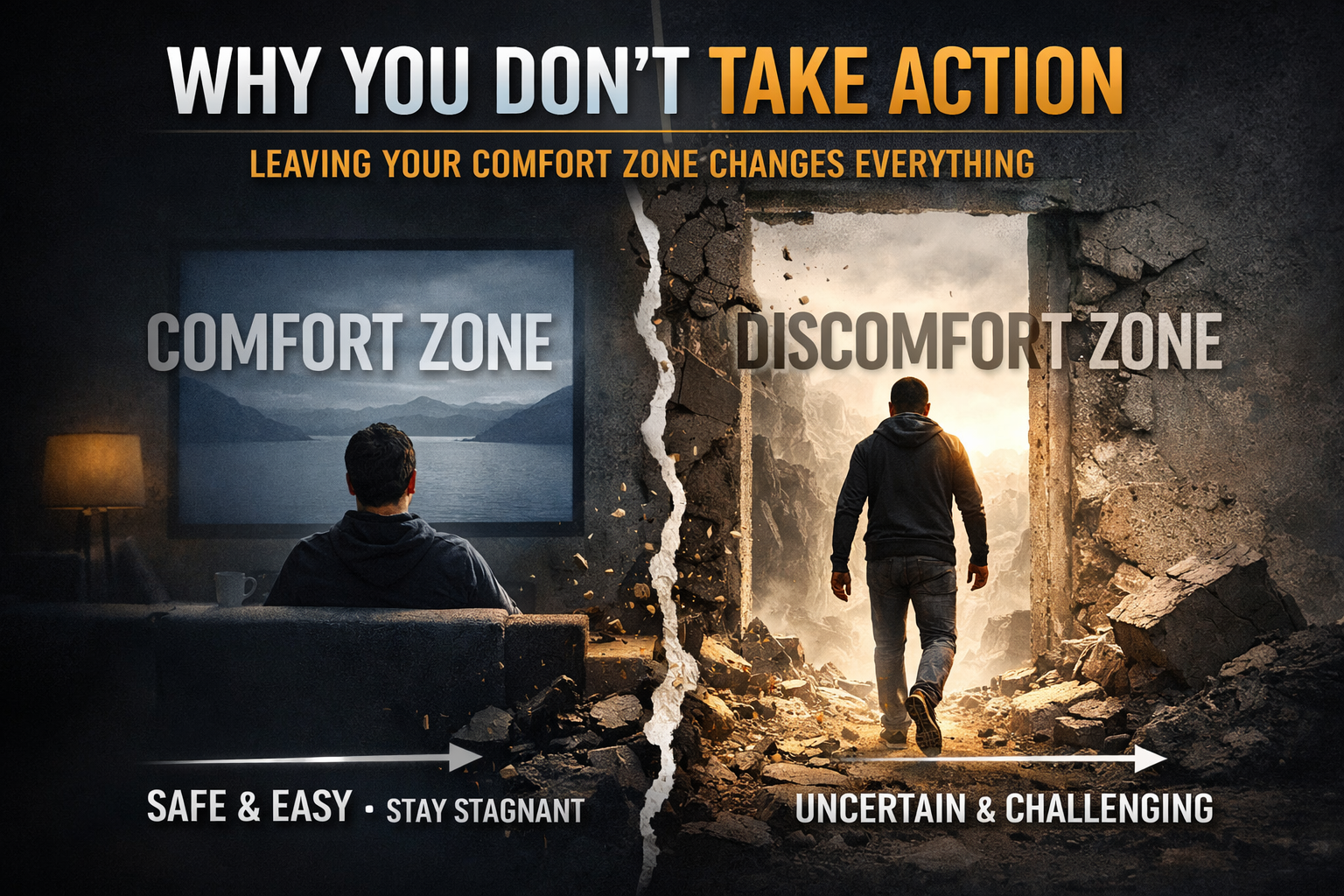
Why You Don’t Take Action (And How Leaving Your Comfort Zone Changes Everything)
The Hidden Force: Comfort as a Constraint
Comfort is not neutral. It’s an active force.
It stabilizes your current state and resists change—regardless of whether that change is positive or necessary. Your brain is wired for efficiency and survival, not expansion. If your current environment provides safety, predictability, and minimal stress, your system sees no urgent reason to deviate.
So even when you want more, your behavior defaults to maintaining what already exists.
This creates a gap:
Cognitive layer: “I want to improve, build, execute.”
Behavioral layer: “Stay where it’s safe, familiar, and low-risk.”
That gap is where most people live indefinitely.
Planning vs. Execution: Two Different Systems
Planning feels like progress—but it’s not execution.
Planning operates in a controlled, low-risk environment. You’re thinking, organizing, optimizing. There’s no exposure. No judgment. No failure.
Execution is different:
It introduces uncertainty
It exposes you to failure
It forces real-world feedback
It disrupts your current equilibrium
Your mind prefers planning because it simulates progress without requiring discomfort.
That’s the trap.
Why You Don’t Act (Even When You Want To)
At a deeper level, you’re not avoiding the task—you’re avoiding the state change that comes with it.
Taking action means:
Breaking your current routine
Losing the predictability of your environment
Facing outcomes you can’t fully control
So your system negotiates: “I’ll start tomorrow.” “I need to refine this more.” “I’ll do it when I feel ready.”
But “ready” is just a disguised form of comfort.
The Reality: Action Requires Discomfort
There is no version of meaningful progress that stays inside your comfort zone.
If you’re comfortable:
You’re not being challenged
You’re not adapting
You’re not expanding capacity
Growth requires entering an uncomfortable zone—a state where:
You feel resistance
You feel uncertainty
You feel exposed
That discomfort is not a signal to stop.
It’s the signal that you’ve finally crossed the threshold into real execution.
Reframing Discomfort
Most people interpret discomfort as danger.
High performers interpret it as alignment.
If it feels uncomfortable, it usually means:
You’re doing something new
You’re operating beyond your current baseline
You’re creating the conditions for change
The goal is not to eliminate discomfort.
The goal is to normalize it.
The Shift: From Comfort-Seeking to Outcome-Driven
Right now, your behavior is optimized for comfort.
To execute, you need to shift your operating principle:
From:
“What feels easy right now?”
To:
“What moves me forward, regardless of how it feels?”
That shift is everything.
Because once you detach action from emotion, execution becomes consistent.
Practical Execution Framework
If you want to break out of this cycle, the solution isn’t more planning—it’s controlled exposure to discomfort.
Reduce the barrier to entry
Don’t aim for perfection
Start with the smallest executable step
Act before you feel ready
Readiness is not a prerequisite
Action creates readiness
Schedule discomfort
Treat execution like a non-negotiable task
Remove the option to “decide later”
Track actions, not intentions
Measure what you did, not what you planned
Build tolerance
The more you operate in discomfort, the less it controls you
The Bottom Line
You don’t have an information problem.
You have a comfort problem.
Your current life is the result of what you’ve been willing to tolerate—and what you’ve been unwilling to disrupt.
If you want different outcomes, you need different behaviors.
And different behaviors require stepping into a state that feels unfamiliar, unstable, and uncomfortable.
That’s not a flaw in the system.
That is the system.
Execution begins the moment you stop negotiating with comfort.