


You Don’t See It While You Have It
A deep breakdown of why we take friendships for granted until they’re gone. Learn how loss reveals value, why familiarity creates blind spots, and how to appreciate meaningful relationships before it’s too late
There’s a strange flaw in how people perceive value: the closer something is to you, the less clearly you see it.
A friendship is one of the easiest things to take for granted—not because it lacks importance, but because it becomes normal. It blends into your daily life. The conversations, the laughs, the shared silence… they stop feeling significant because they’re always there.
Until one day, they aren’t.
---
Familiarity Kills Awareness
When someone is consistently present in your life, your brain stops flagging them as “valuable” and starts labeling them as “expected.”
You assume:
They’ll always pick up the phone
They’ll always understand you
They’ll always be there when things go wrong
That assumption is where the blind spot forms.
You’re not actively appreciating the friendship—you’re operating inside it. And anything you operate inside of becomes invisible over time.
---
Loss Creates Clarity
The moment that friend is gone—whether through distance, conflict, or life shifting directions—something changes immediately.
You start remembering:
The small inside jokes
The random late-night conversations
The feeling of being understood without explaining yourself
What once felt ordinary now feels irreplaceable.
Loss doesn’t create value.
It reveals it.
---
The Cost of Realization
The problem is timing.
Realization almost always comes after the opportunity to act on it has passed.
You think:
“I should’ve reached out more.”
“I didn’t realize how much that mattered.”
“I thought we had more time.”
That’s the cost—understanding comes too late to change the outcome.
---
The Pattern Most People Repeat
This isn’t a one-time mistake. It’s a cycle:
1. Gain something meaningful
2. Normalize it
3. Stop noticing it
4. Lose it
5. Finally understand it
Then repeat—with another person, another opportunity, another phase of life.
Most people live inside this loop without ever breaking it.
---
Breaking the Blind Spot
If you want to operate differently, you have to force awareness before loss happens.
That means:
Treating presence as temporary, not permanent
Acknowledging value while it still exists
Acting like time is limited—because it is
Not in a dramatic way. In a precise way.
Send the message.
Make the call.
Say what actually matters while the person is still there to hear it.
---
Final Thought
You don’t suddenly gain appreciation when something disappears—you finally remove the noise that kept you from seeing it.
The friendship didn’t become valuable when it ended.
It was valuable the entire time.
You just didn’t look at it that way until it was too late.
And that’s the difference between awareness and regret.
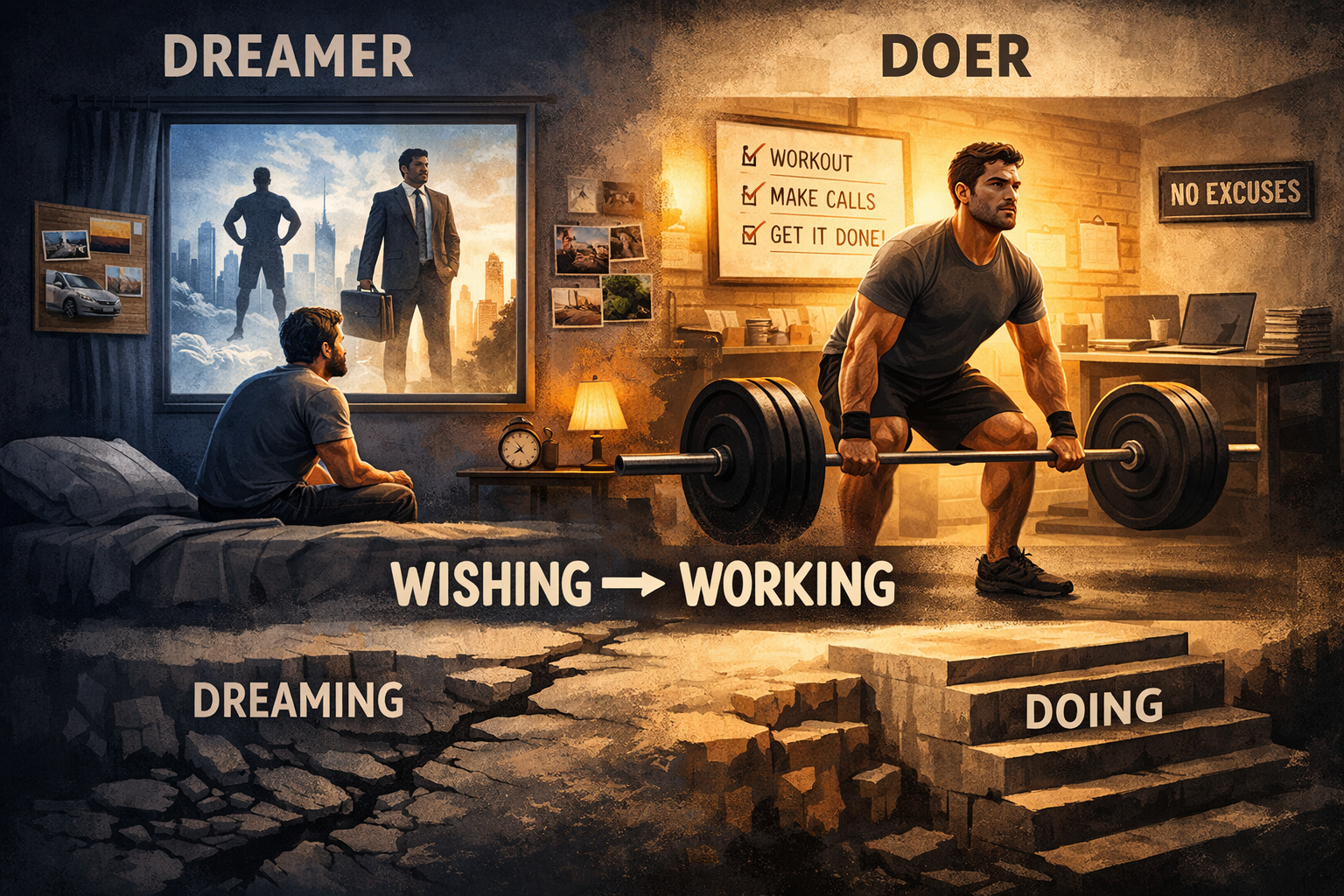
Dreaming Isn’t Doing: The Cost of Living in Possibility Instead of Reality
Many people dream about success but never take action to achieve it. This article breaks down why staying comfortable keeps you stuck, how dreaming becomes an illusion of progress, and what it takes to shift from thinking to execution and real results.
There’s a version of you that exists only in your head.
That version is sharper, richer, more disciplined. They wake up early, execute relentlessly, and build the life you claim you want. You visit that version often—late at night, in moments of isolation, in bursts of motivation. You can see it clearly.
But you don’t live there.
You stay where it’s comfortable.
The Addiction to Possibility
Dreaming feels productive—but it’s a psychological illusion.
When you imagine success, your brain releases a small reward. You feel like you’re progressing, even though nothing has changed. You visualize the business, the physique, the lifestyle—and for a moment, it satisfies the desire without requiring the work.
That’s the trap.
You’re not building the life.
You’re consuming the idea of it.
Over time, this creates a dangerous loop:
You dream → you feel good
You feel good → you delay action
You delay action → nothing changes
Nothing changes → you escape back into dreaming
You become a spectator in your own life.
Why You Avoid Action
It’s not because you don’t know what to do.
It’s because action exposes you.
Dreaming is safe. Execution is not.
When you act:
You can fail
You can look inexperienced
You can be judged
You can realize you're not as good as you thought
So instead, you stay in the mental version—where everything works and nothing is tested.
You protect your identity at the cost of your future.
The Gap Between Identity and Behavior
You might identify as someone who is:
Disciplined
Focused
Driven
But identity without behavior is fiction.
Reality only respects what is repeated.
You don’t become something because you think it.
You become it because you do it consistently, especially when you don’t feel like it.
There is a measurable gap between:
Who you say you are
And what you actually do daily
That gap is your real life.
Comfort Is the Real Enemy
Most people don’t fail because they lack ambition.
They fail because they are too comfortable.
Comfort removes urgency.
Comfort delays decisions.
Comfort convinces you that “tomorrow” is always available.
But every day you delay:
Your standards drop
Your discipline weakens
Your dream becomes less real
Eventually, you don’t even believe your own vision anymore.
Execution Is the Only Translation
Dreams are just raw data.
Execution is the translation into reality.
Without execution:
Vision = entertainment
Goals = decoration
Potential = wasted capacity
The people who build what you admire aren’t more motivated than you.
They just act more than they think.
They move before they feel ready.
They produce before they feel confident.
They fail, adjust, and continue—while you’re still visualizing.
The Shift: From Dreamer to Operator
If you want to break the cycle, the shift is simple—but not easy:
Stop asking:
“What do I want to be?”
Start asking:
“What do I need to do today to move 1% closer?”
Then do it—without negotiation.
No overthinking.
No waiting for the perfect mood.
No building the “ideal plan.”
Just action.
Because action compounds:
One task becomes momentum
Momentum becomes discipline
Discipline becomes identity
And identity becomes reality.
Final Thought
There are two versions of your life:
The one you imagine
The one you execute
Only one of them is real.
And every day, you’re choosing which one you live in.
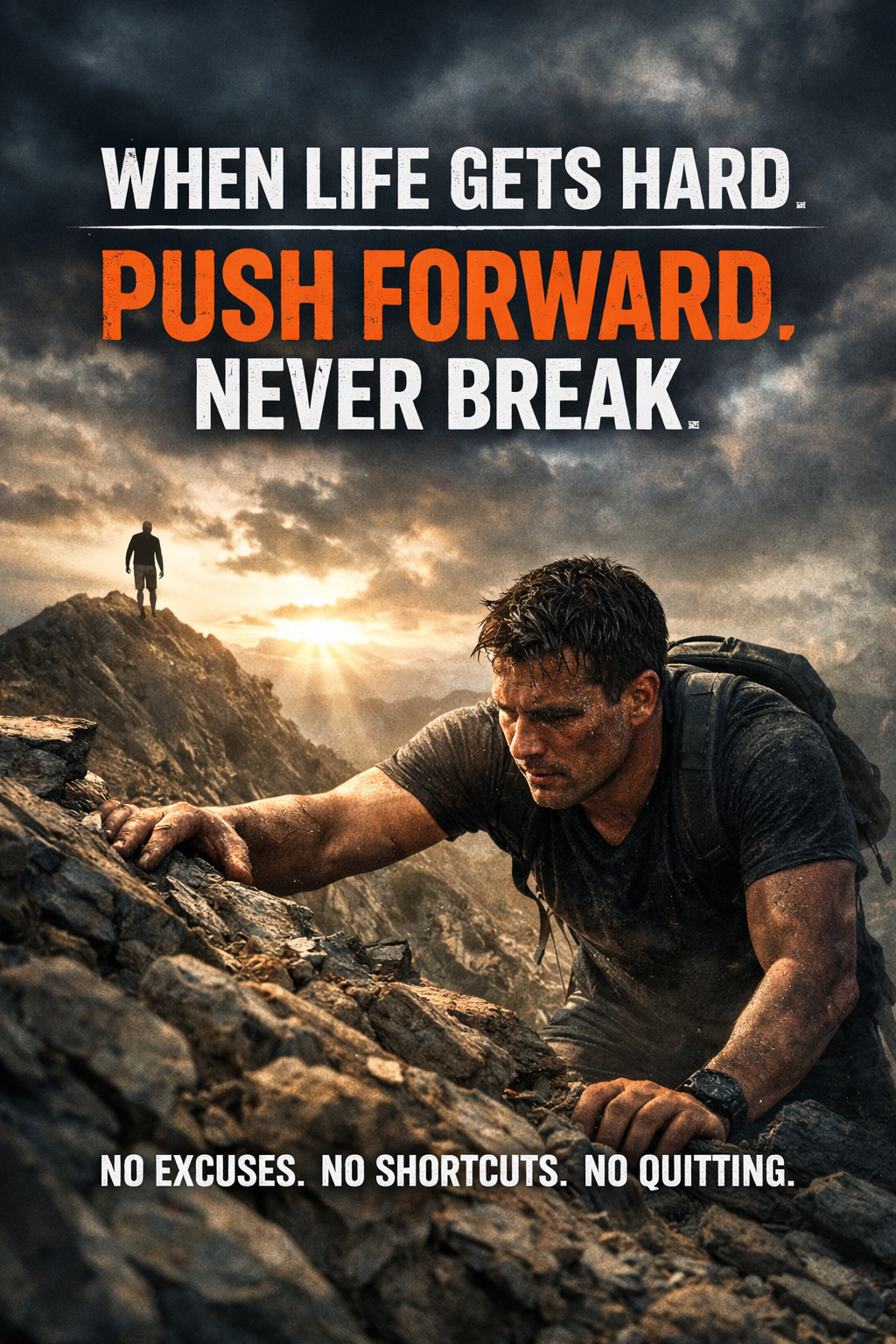
When Life Gets Hard, That’s the Point
Most people want success, but few are prepared for the difficulty it requires. Learn why pushing forward through hard times builds discipline, resilience, and long-term success—and why quitting keeps you stuck
There’s a moment everyone reaches—when the path they chose stops feeling exciting and starts feeling heavy. The vision is still there, the goal still matters, but the reality of what it takes begins to show itself. That’s where most people quietly step back.
Not because they don’t want success.
But because they didn’t realize what success actually demands.
The Illusion of an Easy Life
People say they want a better life.
More money. More freedom. More control.
But what they really want is the feeling of those things—without the weight required to earn them.
They want the outcome without the process.
The truth is, the life most people chase is inherently difficult. It requires discipline when you don’t feel like it. It requires consistency when results are invisible. It requires pressure, sacrifice, and long periods where nothing feels like it’s working.
So when that reality hits, they start looking for exits:
Shortcuts
Excuses
New directions that feel easier
But those “easier” paths usually lead right back to the same place—stagnation.
Pressure Is Not the Problem—It’s the Filter
When things get hard, it’s not a sign to stop.
It’s a signal.
Pressure exposes what’s real:
Your discipline
Your standards
Your ability to stay aligned when comfort disappears
Most people break here because they built their pursuit on motivation, not structure.
Motivation fades. Structure doesn’t.
If you rely on how you feel, you will fold the moment it stops feeling good. If you rely on systems, habits, and standards, you move regardless of emotion.
That’s the separation.
Don’t Let Anyone Break You Down
When you’re in that difficult phase, it’s not just internal pressure—you’ll feel it externally too.
People will question you.
Doubt you.
Project their own limitations onto you.
Not always out of hate—but because your path forces them to confront what they’re avoiding in their own lives.
If you listen too closely, you’ll start negotiating with yourself:
“Maybe I should slow down.”
“Maybe this isn’t worth it.”
“Maybe they’re right.”
That’s how people lose momentum—not in one big decision, but in small compromises.
You can’t let outside noise override internal direction.
The Reality: Hard Is the Requirement
There is no version of a meaningful life that doesn’t include difficulty.
The challenge is the path.
Want discipline? It’s built through discomfort.
Want confidence? It’s built through pressure.
Want success? It’s built through sustained effort when quitting feels easier.
If it feels hard, you’re not off track—you’re finally on it.
Push Forward Anyway
There will be days where nothing feels aligned.
Where progress looks invisible.
Where quitting feels logical.
Push forward anyway.
Not emotionally. Not dramatically. Just deliberately.
One action.
One task.
One step that keeps the direction intact.
That’s how momentum is built—not through massive breakthroughs, but through refusing to stop when everything in you wants to.
Controlled Closing
Most people don’t fail because life is too hard.
They fail because they expected it to be easier than it actually is.
If you understand that difficulty is part of the design—not a flaw in it—you stop resisting it.
And once you stop resisting it, you start using it.
That’s when everything changes.

The Power of Small Steps: How Baby Moves Become Big Leaps
Learn how small daily actions compound into powerful life results. Discover how consistent habits, discipline, and aligned execution turn baby steps into massive breakthroughs over time
There’s a quiet truth most people overlook: progress rarely feels powerful in the moment. It feels small. Almost insignificant. Like nothing is really changing.
You tell yourself you’re going to build something bigger—a better body, a stronger mindset, a successful path, a life with direction. You map it out in your head. You see the end result clearly.
But when it comes time to act, what’s in front of you doesn’t look like a breakthrough.
It looks like a small task.
A single workout.
A page read.
A note written.
A message sent.
And because it feels small, people underestimate it.
Small Actions Are Not Small Outcomes
The mistake is thinking that big results come from big actions.
They don’t.
They come from aligned repetition.
One task done today doesn’t change your life. But one task done every day starts building structure. That structure builds momentum. And momentum, over time, becomes force.
Think of it like this:
You don’t become disciplined in one decision—you become disciplined through hundreds of them.
You don’t build success in one move—you build it through consistent execution.
Every small action is a vote for the person you’re becoming.
Alignment Is Everything
Not all small steps matter. Random effort doesn’t create results.
The steps have to be aligned with where you’re going.
If your long-term goal is strength, your daily step might be showing up to train—even when it’s inconvenient.
If your goal is financial freedom, your step might be learning, saving, or building something—even if it feels slow.
If your goal is building something meaningful, your step might be writing, creating, or thinking deeper every day.
Individually, each action feels like nothing.
But when they’re pointed in the same direction, they stack.
Compounding Turns Steps Into Leaps
There’s a moment—most people don’t see it coming—where everything starts to connect.
The things you’ve been doing quietly, consistently, start producing visible results.
What used to feel like effort becomes habit.
What used to feel slow becomes natural.
What used to feel small becomes undeniable.
That’s when the “baby steps” turn into what looks like a leap from the outside.
But it’s not a leap.
It’s accumulation finally showing itself.
The Discipline to Keep Going When It Feels Small
The hardest part isn’t starting.
It’s continuing when it feels like it’s not working.
Because there’s a gap between effort and visible reward.
In that gap, most people quit.
They want confirmation that what they’re doing matters. They want to feel progress immediately. But real progress is often invisible at first.
The people who move forward in life understand this:
You don’t need to feel progress—you need to trust the process.
Build Your Life One Step at a Time
If you zoom out too far, your goals will overwhelm you.
If you zoom in just enough, you’ll see something manageable.
That’s where power is.
Not in doing everything at once—but in doing the next step with intention.
So instead of asking:
“How do I change my entire life?”
Ask:
“What is the next small step that moves me forward?”
Then do it.
And do it again tomorrow.
Because one day, without realizing it, you won’t be taking small steps anymore.
You’ll be moving differently. Thinking differently. Operating at a higher level.
And to everyone else—it’ll look like you made a big leap.
But you’ll know the truth.
It started with something small.
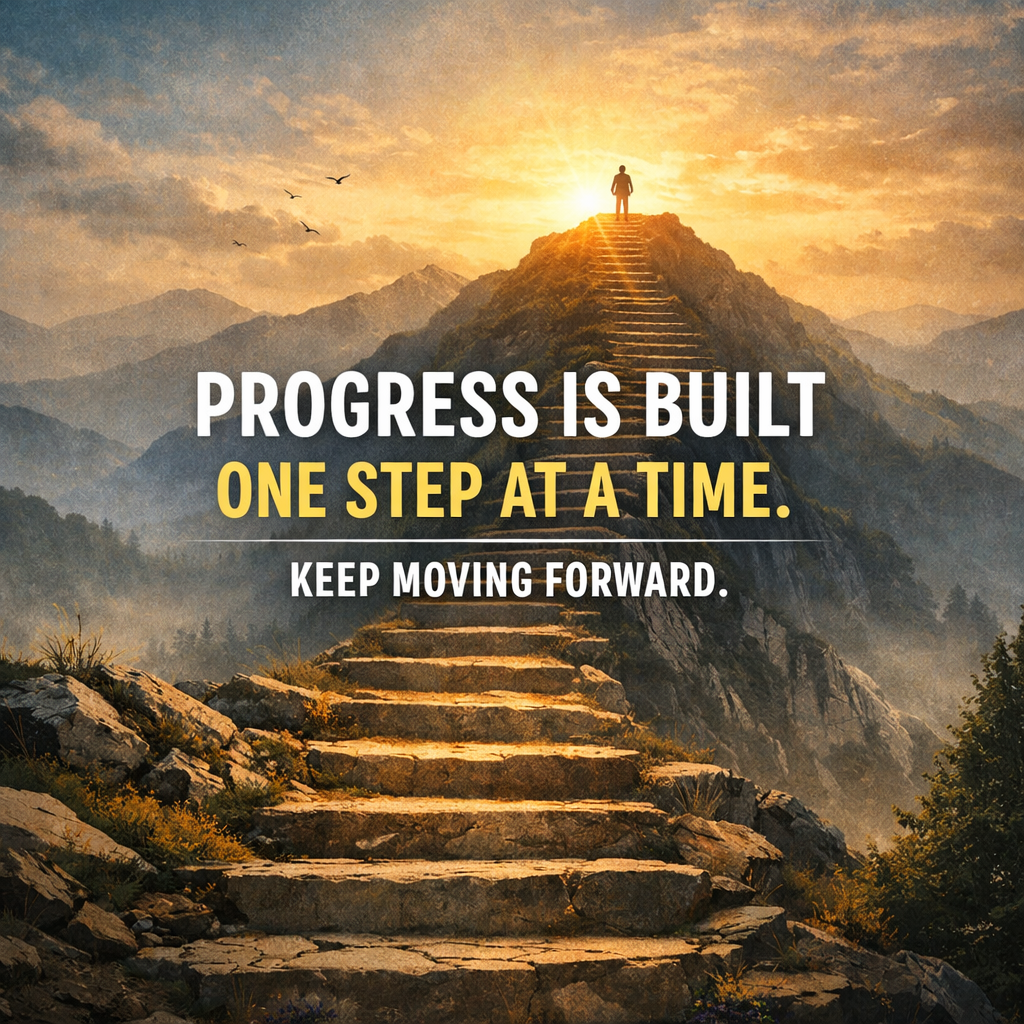
Progress Is Built One Step at a Time (Why You Never Feel Like You’ve “Made It”)
Most people expect progress to feel like a breakthrough—but it doesn’t. This article breaks down why growth feels slow, why you never feel like you’ve “made it,” and how real success is built one step at a time
There’s a moment people expect when they reach a milestone.
A feeling of arrival.
A sense that everything has changed.
But most of the time, it doesn’t feel like that at all.
You finish something—a course, a phase, a chapter—and instead of everything slowing down, life keeps moving. There’s another step waiting. Another level. Another demand.
And that’s where most people get it wrong.
The Illusion of “Making It”
At the beginning, you imagine a finish line.
You think: “Once I get through this, things will click.”
But when you finally reach that point, nothing magical happens. There’s no dramatic shift in who you are overnight.
You don’t suddenly feel complete.
You just… continue.
And that’s not failure.
That’s reality.
What Finishing Something Actually Means
Completing a phase of your life isn’t about the moment itself—it’s about what it proves.
It proves that:
You can commit and follow through
You can stay consistent even when it’s repetitive
You can push through when it stops being exciting
You can build something over time
That’s the real win.
Not the finish line—but the evidence that you’re capable of reaching it.
Why Progress Feels Invisible
Here’s the truth most people don’t talk about:
Progress feels ordinary.
You wake up.
You do the work.
You repeat the process.
Day after day, it feels like nothing is changing.
But then you look back—and you’re somewhere new.
That’s how growth works.
Not in sudden breakthroughs, but in stacked days of effort.
The Next Step Is Always There
The moment you finish something, there’s always another step.
Another challenge. Another environment. Another level of responsibility.
And it can feel like you’re just doing more of the same.
But you’re not.
You’re building momentum.
Every step forward compounds the last one—even if it doesn’t feel significant in the moment.
The Discipline That Changes Everything
Most people stop when it stops feeling exciting.
They need motivation. They need a big reason. They need it to feel important.
But real progress comes from something else:
The ability to keep going without needing it to feel special.
To move forward because it’s the next step—not because it’s exciting.
That’s where separation happens.
Zoom Out
If you feel like you’re just “going through another phase,” take a step back.
You’re not where you started.
You’ve moved forward—even if it feels small.
And those small steps?
They’re not small over time.
They build direction.
They build structure.
They build a life.
Keep Moving
You don’t need everything to make sense right now.
You don’t need to feel like you’ve “made it.”
You just need to keep going.
One step after the other.
One phase into the next.
Because that’s how progress actually works.
And if you stay in motion long enough—
You’ll end up exactly where you said you wanted to go.
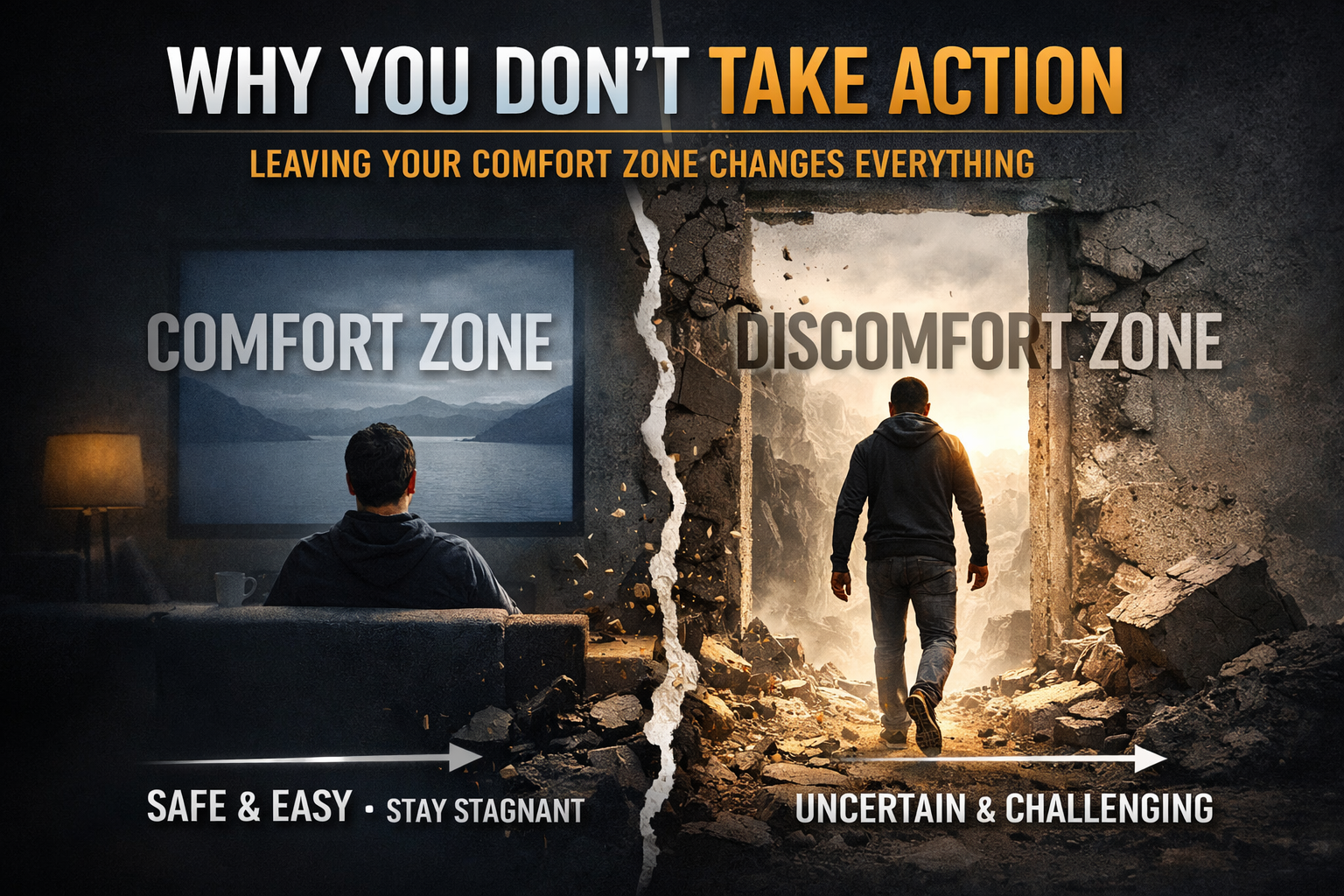
Why You Don’t Take Action (And How Leaving Your Comfort Zone Changes Everything)
The Hidden Force: Comfort as a Constraint
Comfort is not neutral. It’s an active force.
It stabilizes your current state and resists change—regardless of whether that change is positive or necessary. Your brain is wired for efficiency and survival, not expansion. If your current environment provides safety, predictability, and minimal stress, your system sees no urgent reason to deviate.
So even when you want more, your behavior defaults to maintaining what already exists.
This creates a gap:
Cognitive layer: “I want to improve, build, execute.”
Behavioral layer: “Stay where it’s safe, familiar, and low-risk.”
That gap is where most people live indefinitely.
Planning vs. Execution: Two Different Systems
Planning feels like progress—but it’s not execution.
Planning operates in a controlled, low-risk environment. You’re thinking, organizing, optimizing. There’s no exposure. No judgment. No failure.
Execution is different:
It introduces uncertainty
It exposes you to failure
It forces real-world feedback
It disrupts your current equilibrium
Your mind prefers planning because it simulates progress without requiring discomfort.
That’s the trap.
Why You Don’t Act (Even When You Want To)
At a deeper level, you’re not avoiding the task—you’re avoiding the state change that comes with it.
Taking action means:
Breaking your current routine
Losing the predictability of your environment
Facing outcomes you can’t fully control
So your system negotiates: “I’ll start tomorrow.” “I need to refine this more.” “I’ll do it when I feel ready.”
But “ready” is just a disguised form of comfort.
The Reality: Action Requires Discomfort
There is no version of meaningful progress that stays inside your comfort zone.
If you’re comfortable:
You’re not being challenged
You’re not adapting
You’re not expanding capacity
Growth requires entering an uncomfortable zone—a state where:
You feel resistance
You feel uncertainty
You feel exposed
That discomfort is not a signal to stop.
It’s the signal that you’ve finally crossed the threshold into real execution.
Reframing Discomfort
Most people interpret discomfort as danger.
High performers interpret it as alignment.
If it feels uncomfortable, it usually means:
You’re doing something new
You’re operating beyond your current baseline
You’re creating the conditions for change
The goal is not to eliminate discomfort.
The goal is to normalize it.
The Shift: From Comfort-Seeking to Outcome-Driven
Right now, your behavior is optimized for comfort.
To execute, you need to shift your operating principle:
From:
“What feels easy right now?”
To:
“What moves me forward, regardless of how it feels?”
That shift is everything.
Because once you detach action from emotion, execution becomes consistent.
Practical Execution Framework
If you want to break out of this cycle, the solution isn’t more planning—it’s controlled exposure to discomfort.
Reduce the barrier to entry
Don’t aim for perfection
Start with the smallest executable step
Act before you feel ready
Readiness is not a prerequisite
Action creates readiness
Schedule discomfort
Treat execution like a non-negotiable task
Remove the option to “decide later”
Track actions, not intentions
Measure what you did, not what you planned
Build tolerance
The more you operate in discomfort, the less it controls you
The Bottom Line
You don’t have an information problem.
You have a comfort problem.
Your current life is the result of what you’ve been willing to tolerate—and what you’ve been unwilling to disrupt.
If you want different outcomes, you need different behaviors.
And different behaviors require stepping into a state that feels unfamiliar, unstable, and uncomfortable.
That’s not a flaw in the system.
That is the system.
Execution begins the moment you stop negotiating with comfort.
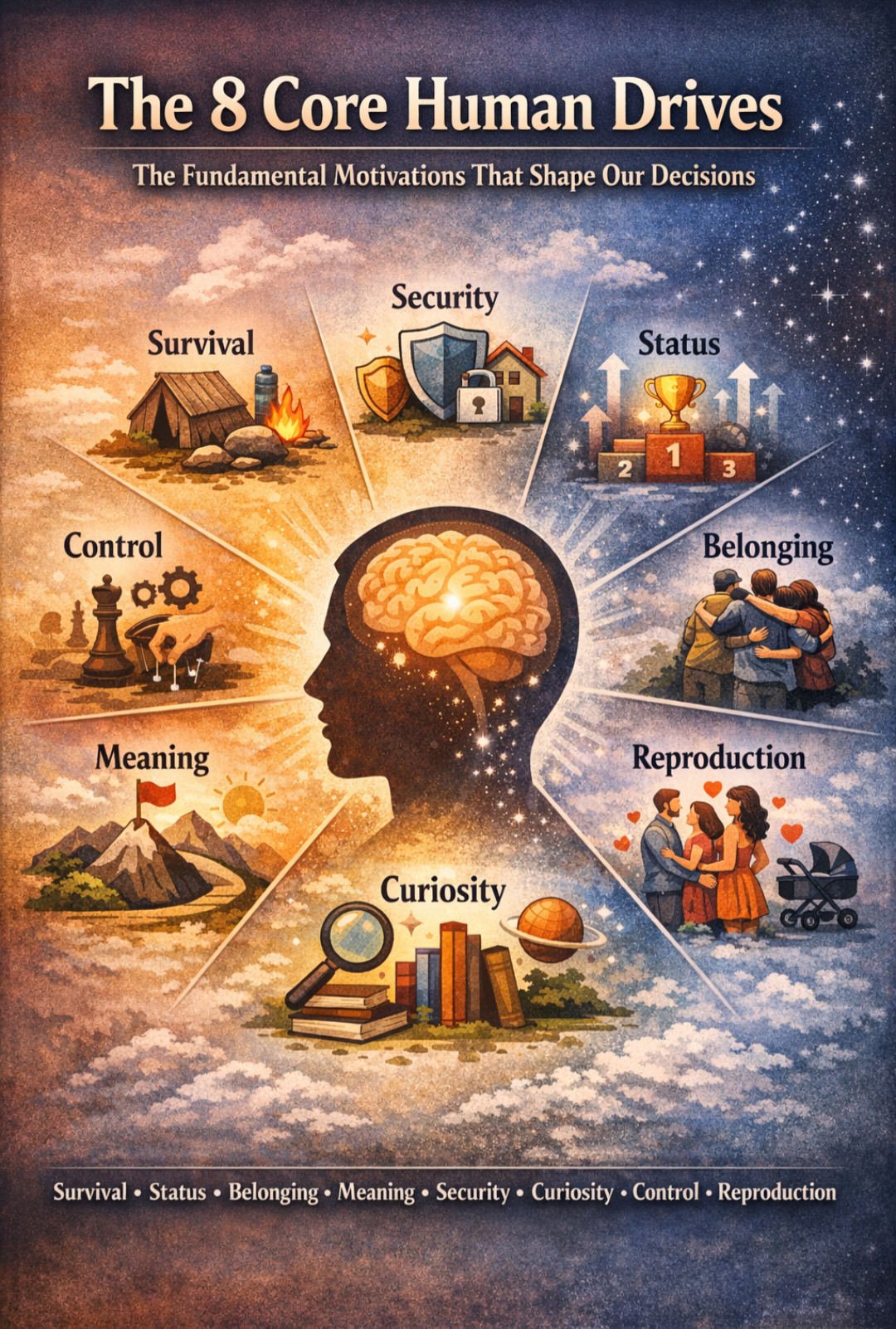
Human Cores that drives us
The 8 Core Human Drives
1. Survival
The most fundamental drive is the instinct to stay alive and avoid harm.
This includes:
food and water
shelter
safety
health
risk avoidance
This drive is studied heavily in **Evolutionary Psychology and **Behavioral Biology.
Even modern decisions—insurance, savings, security systems—often reflect survival instincts.
Example behaviors
avoiding danger
building safety systems
risk management
2. Security
Humans seek stability and protection from uncertainty.
Security includes:
financial stability
job security
physical protection
cybersecurity
national defense
Security institutions arise because societies try to manage this drive.
Fields studying this include **Security Studies and **Political Science.
3. Status
Humans compete for rank within social hierarchies.
Status signals can include:
wealth
competence
reputation
authority
recognition
Status competition explains:
career ambition
luxury goods markets
political rivalry
social media behavior
This concept is central in **Social Psychology.
4. Belonging
Humans evolved as tribal social creatures.
People strongly desire:
community
friendship
family
ideological groups
Belonging explains:
political tribes
fandom communities
religious affiliation
This drive is studied in **Sociology.
5. Reproduction & Attraction
Humans seek romantic relationships and family creation.
This drive shapes:
attraction
dating behavior
marriage
family structures
It is central to **Evolutionary Biology and **Human Sexuality Studies.
Even many status behaviors historically evolved as mating signals.
6. Curiosity
Humans possess a strong drive to explore and understand the world.
This drive fuels:
science
technology
education
innovation
discovery
Fields like **Cognitive Science study curiosity and learning behavior.
Curiosity is a major driver of human progress.
7. Control
Humans desire agency over their environment and decisions.
Control includes:
personal autonomy
influence over others
ownership of resources
leadership
Loss of control often creates anxiety and conflict.
This drive influences politics, business leadership, and power struggles.
8. Meaning
Humans seek purpose and significance in their lives.
Meaning is often found through:
religion
ideology
philosophy
long-term goals
legacy
This drive is explored in **Existential Psychology and **Philosophy.
Meaning helps people endure hardship and pursue long-term visions.
How These Drives Interact
Most human actions combine several drives simultaneously.
Example:
Starting a company might satisfy:
status (achievement)
control (ownership)
security (financial stability)
meaning (purpose)
Political movements may combine:
belonging
status
meaning
security
These drives interact constantly in complex ways.
Why Understanding These Drives Matters
If you understand these motivations, you can better understand:
why people buy products
why societies form ideologies
why conflicts occur
why leaders gain followers
Most institutions, markets, and cultures are designed around these drives.

Military Structure as an Execution Advantage
Military Structure as an Execution Advantage
Written By Dallas Brown
There is a fundamental difference between motivation and structure.
Motivation is emotional.
Structure is operational.
The military does not rely on how someone feels on a given day. It relies on systems — repeatable processes designed to produce consistent outcomes under stress, uncertainty, and constraint.
That distinction becomes a long-term execution advantage.
Structure Removes Negotiation
In civilian environments, execution often depends on internal negotiation:
“Do I feel like training today?”
“Should I study later?”
“I’ll get to it tomorrow.”
In structured military environments, negotiation is minimized. Standards exist independent of emotion. Tasks are completed because they are required, not because they are convenient.
Over time, this reduces cognitive drag.
Less decision fatigue.
Less emotional volatility.
More predictable output.
Consistency compounds.
Process Over Intensity
High performance is rarely about intensity. It is about repeatability.
Military systems prioritize:
Checklists
Standard operating procedures
After-action reviews
Chain of command clarity
Defined accountability
This produces steady execution, even when energy fluctuates.
In long-horizon careers — cybersecurity, infrastructure, technical fields — this matters more than short bursts of enthusiasm.
Competence is built through repetition inside structure.
Stress Conditioning
Another advantage: structured environments normalize pressure.
Deadlines.
Inspection standards.
Evaluation cycles.
Operational consequences.
You learn to execute while tired.
You learn to execute without perfect conditions.
You learn to execute without applause.
That resilience translates directly into civilian strategic positioning.
While others wait for optimal circumstances, structured operators move regardless.
Systems Thinking as Leverage
Military structure trains you to think in systems:
Inputs → process → outputs
Clear responsibilities
Defined feedback loops
Measurable standards
This mindset becomes powerful outside uniform.
In technology, cybersecurity, and infrastructure, systems thinking is leverage. Problems are rarely emotional. They are architectural.
Structure conditions you to solve at that level.
Long-Term Impact
The real advantage is not visible immediately.
It shows up years later:
Compounded skill acquisition
Controlled decision-making
Reduced impulsivity
Stronger strategic positioning
Structure builds durability.
And durability is a competitive advantage in a world optimized for noise and short-term validation.
Military structure is not about rigidity.
It is about disciplined execution within defined systems.
When applied intentionally in civilian life, it becomes an asymmetric advantage.
Not louder.
Not flashier.
Just more consistent — and consistency builds leverage over time.
There is a fundamental difference between motivation and structure.
Motivation is emotional.
Structure is operational.
The military does not rely on how someone feels on a given day. It relies on systems — repeatable processes designed to produce consistent outcomes under stress, uncertainty, and constraint.
That distinction becomes a long-term execution advantage.
Structure Removes Negotiation
In civilian environments, execution often depends on internal negotiation:
“Do I feel like training today?”
“Should I study later?”
“I’ll get to it tomorrow.”
In structured military environments, negotiation is minimized. Standards exist independent of emotion. Tasks are completed because they are required, not because they are convenient.
Over time, this reduces cognitive drag.
Less decision fatigue.
Less emotional volatility.
More predictable output.
Consistency compounds.
Process Over Intensity
High performance is rarely about intensity. It is about repeatability.
Military systems prioritize:
Checklists
Standard operating procedures
After-action reviews
Chain of command clarity
Defined accountability
This produces steady execution, even when energy fluctuates.
In long-horizon careers — cybersecurity, infrastructure, technical fields — this matters more than short bursts of enthusiasm.
Competence is built through repetition inside structure.
Stress Conditioning
Another advantage: structured environments normalize pressure.
Deadlines.
Inspection standards.
Evaluation cycles.
Operational consequences.
You learn to execute while tired.
You learn to execute without perfect conditions.
You learn to execute without applause.
That resilience translates directly into civilian strategic positioning.
While others wait for optimal circumstances, structured operators move regardless.
Systems Thinking as Leverage
Military structure trains you to think in systems:
Inputs → process → outputs
Clear responsibilities
Defined feedback loops
Measurable standards
This mindset becomes powerful outside uniform.
In technology, cybersecurity, and infrastructure, systems thinking is leverage. Problems are rarely emotional. They are architectural.
Structure conditions you to solve at that level.
Long-Term Impact
The real advantage is not visible immediately.
It shows up years later:
Compounded skill acquisition
Controlled decision-making
Reduced impulsivity
Stronger strategic positioning
Structure builds durability.
And durability is a competitive advantage in a world optimized for noise and short-term validation.
Military structure is not about rigidity.
It is about disciplined execution within defined systems.
When applied intentionally in civilian life, it becomes an asymmetric advantage.
Not louder.
Not flashier.
Just more consistent — and consistency builds leverage over time.