

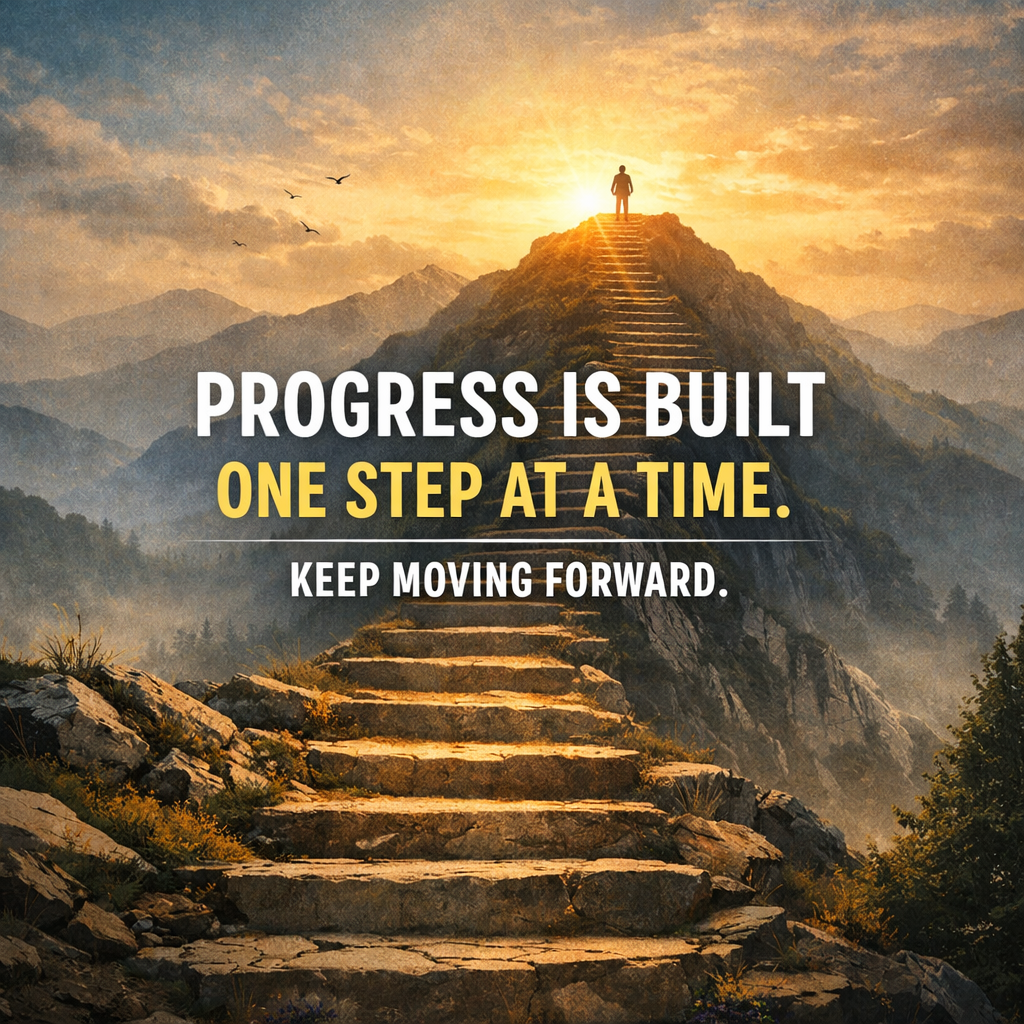
Progress Is Built One Step at a Time (Why You Never Feel Like You’ve “Made It”)
Most people expect progress to feel like a breakthrough—but it doesn’t. This article breaks down why growth feels slow, why you never feel like you’ve “made it,” and how real success is built one step at a time
There’s a moment people expect when they reach a milestone.
A feeling of arrival.
A sense that everything has changed.
But most of the time, it doesn’t feel like that at all.
You finish something—a course, a phase, a chapter—and instead of everything slowing down, life keeps moving. There’s another step waiting. Another level. Another demand.
And that’s where most people get it wrong.
The Illusion of “Making It”
At the beginning, you imagine a finish line.
You think: “Once I get through this, things will click.”
But when you finally reach that point, nothing magical happens. There’s no dramatic shift in who you are overnight.
You don’t suddenly feel complete.
You just… continue.
And that’s not failure.
That’s reality.
What Finishing Something Actually Means
Completing a phase of your life isn’t about the moment itself—it’s about what it proves.
It proves that:
You can commit and follow through
You can stay consistent even when it’s repetitive
You can push through when it stops being exciting
You can build something over time
That’s the real win.
Not the finish line—but the evidence that you’re capable of reaching it.
Why Progress Feels Invisible
Here’s the truth most people don’t talk about:
Progress feels ordinary.
You wake up.
You do the work.
You repeat the process.
Day after day, it feels like nothing is changing.
But then you look back—and you’re somewhere new.
That’s how growth works.
Not in sudden breakthroughs, but in stacked days of effort.
The Next Step Is Always There
The moment you finish something, there’s always another step.
Another challenge. Another environment. Another level of responsibility.
And it can feel like you’re just doing more of the same.
But you’re not.
You’re building momentum.
Every step forward compounds the last one—even if it doesn’t feel significant in the moment.
The Discipline That Changes Everything
Most people stop when it stops feeling exciting.
They need motivation. They need a big reason. They need it to feel important.
But real progress comes from something else:
The ability to keep going without needing it to feel special.
To move forward because it’s the next step—not because it’s exciting.
That’s where separation happens.
Zoom Out
If you feel like you’re just “going through another phase,” take a step back.
You’re not where you started.
You’ve moved forward—even if it feels small.
And those small steps?
They’re not small over time.
They build direction.
They build structure.
They build a life.
Keep Moving
You don’t need everything to make sense right now.
You don’t need to feel like you’ve “made it.”
You just need to keep going.
One step after the other.
One phase into the next.
Because that’s how progress actually works.
And if you stay in motion long enough—
You’ll end up exactly where you said you wanted to go.

Military Structure as an Execution Advantage
Military Structure as an Execution Advantage
Written By Dallas Brown
There is a fundamental difference between motivation and structure.
Motivation is emotional.
Structure is operational.
The military does not rely on how someone feels on a given day. It relies on systems — repeatable processes designed to produce consistent outcomes under stress, uncertainty, and constraint.
That distinction becomes a long-term execution advantage.
Structure Removes Negotiation
In civilian environments, execution often depends on internal negotiation:
“Do I feel like training today?”
“Should I study later?”
“I’ll get to it tomorrow.”
In structured military environments, negotiation is minimized. Standards exist independent of emotion. Tasks are completed because they are required, not because they are convenient.
Over time, this reduces cognitive drag.
Less decision fatigue.
Less emotional volatility.
More predictable output.
Consistency compounds.
Process Over Intensity
High performance is rarely about intensity. It is about repeatability.
Military systems prioritize:
Checklists
Standard operating procedures
After-action reviews
Chain of command clarity
Defined accountability
This produces steady execution, even when energy fluctuates.
In long-horizon careers — cybersecurity, infrastructure, technical fields — this matters more than short bursts of enthusiasm.
Competence is built through repetition inside structure.
Stress Conditioning
Another advantage: structured environments normalize pressure.
Deadlines.
Inspection standards.
Evaluation cycles.
Operational consequences.
You learn to execute while tired.
You learn to execute without perfect conditions.
You learn to execute without applause.
That resilience translates directly into civilian strategic positioning.
While others wait for optimal circumstances, structured operators move regardless.
Systems Thinking as Leverage
Military structure trains you to think in systems:
Inputs → process → outputs
Clear responsibilities
Defined feedback loops
Measurable standards
This mindset becomes powerful outside uniform.
In technology, cybersecurity, and infrastructure, systems thinking is leverage. Problems are rarely emotional. They are architectural.
Structure conditions you to solve at that level.
Long-Term Impact
The real advantage is not visible immediately.
It shows up years later:
Compounded skill acquisition
Controlled decision-making
Reduced impulsivity
Stronger strategic positioning
Structure builds durability.
And durability is a competitive advantage in a world optimized for noise and short-term validation.
Military structure is not about rigidity.
It is about disciplined execution within defined systems.
When applied intentionally in civilian life, it becomes an asymmetric advantage.
Not louder.
Not flashier.
Just more consistent — and consistency builds leverage over time.
There is a fundamental difference between motivation and structure.
Motivation is emotional.
Structure is operational.
The military does not rely on how someone feels on a given day. It relies on systems — repeatable processes designed to produce consistent outcomes under stress, uncertainty, and constraint.
That distinction becomes a long-term execution advantage.
Structure Removes Negotiation
In civilian environments, execution often depends on internal negotiation:
“Do I feel like training today?”
“Should I study later?”
“I’ll get to it tomorrow.”
In structured military environments, negotiation is minimized. Standards exist independent of emotion. Tasks are completed because they are required, not because they are convenient.
Over time, this reduces cognitive drag.
Less decision fatigue.
Less emotional volatility.
More predictable output.
Consistency compounds.
Process Over Intensity
High performance is rarely about intensity. It is about repeatability.
Military systems prioritize:
Checklists
Standard operating procedures
After-action reviews
Chain of command clarity
Defined accountability
This produces steady execution, even when energy fluctuates.
In long-horizon careers — cybersecurity, infrastructure, technical fields — this matters more than short bursts of enthusiasm.
Competence is built through repetition inside structure.
Stress Conditioning
Another advantage: structured environments normalize pressure.
Deadlines.
Inspection standards.
Evaluation cycles.
Operational consequences.
You learn to execute while tired.
You learn to execute without perfect conditions.
You learn to execute without applause.
That resilience translates directly into civilian strategic positioning.
While others wait for optimal circumstances, structured operators move regardless.
Systems Thinking as Leverage
Military structure trains you to think in systems:
Inputs → process → outputs
Clear responsibilities
Defined feedback loops
Measurable standards
This mindset becomes powerful outside uniform.
In technology, cybersecurity, and infrastructure, systems thinking is leverage. Problems are rarely emotional. They are architectural.
Structure conditions you to solve at that level.
Long-Term Impact
The real advantage is not visible immediately.
It shows up years later:
Compounded skill acquisition
Controlled decision-making
Reduced impulsivity
Stronger strategic positioning
Structure builds durability.
And durability is a competitive advantage in a world optimized for noise and short-term validation.
Military structure is not about rigidity.
It is about disciplined execution within defined systems.
When applied intentionally in civilian life, it becomes an asymmetric advantage.
Not louder.
Not flashier.
Just more consistent — and consistency builds leverage over time.